Maine Sea Grant – NOAA Fisheries Undergraduate Internships in Sea-run Fish Research
Summer 2026 – Paid Internships
This opportunity is closed.
Maine Sea Grant is partnering with NOAA’s Northeast Fisheries Science Center (NEFSC) to
provide opportunities for undergraduates to gain experience in the field of fisheries. We are
currently recruiting interested students for participation in the Summer 2026 Undergraduate
Internships in Diadromous Ecosystem Research Program.
Several Undergraduate Paid Internships are available (links below) through an ongoing
collaboration between UMaine’s Sea Grant Program and NOAA’s Northeast Fisheries Science
Center. These competitive positions will be 40 hours per week, based at one of several mentor
locations in Maine including UMaine Orono and Maine Department of Marine Resources offices
in Augusta and Jonesboro. Anticipated start date is early May, 2026 with the positions running
12 weeks. Projects include:
Projects
Project Title: Range-wide Atlantic Salmon Growth Study
Project Location: NEFSC (Woods Hole MA or Orono)
Project Leader: Brandon Ellingson (Brandon.Ellingson@noaa.gov)
Project Time Frame: May 2026 – August 2026 (flexible with student/mentor schedules)
Total Hours: up to 480
Semester Hour Allocation: 40 hours per week
Pay Rate: $19.25/hour
NOAA Northeast Fisheries Science Center’s Atlantic Salmon Ecosystems Branch (AtSEB) is participating in an international collaborative Atlantic salmon basin-wide marine growth study. Participating countries/agencies are working to collate representative scale image datasets from adult returns within their regions that are representative of their regional stock characteristics and productivity. These scale image datasets will be processed by an automated scale measurement tool that utilizes convolutional neural networks to extract salmon growth data in a standardized and efficient manner. The resulting dataset will be analyzed for global and regional signals in marine growth and will seek to identify large scale drivers of marine productivity. The AtSEB requires assistance in collating the U.S. scale image dataset which will be the primary task for this position. Additionally, this position will also provide the opportunity to analyze USA growth data extracted using the automated tool and to assist with field preparation and literature support as required.
The intern(s) would assist in:
- Literature reviews related to cold-water fish habitat requirements
- Field data collection
- Data entry, analysis and summation, and develop subject literature reviews for the project(s)
- Skills in GIS program and databases are preferred
Opportunities Include:
- Exposure to a wide range of fisheries topics related to ecosystem monitoring, climate variability and trophic ecology
- Developing essential laboratory and analytical skills
- Working independently with guidance from the Principal Investigators
- Maintaining detailed databases, conducting data QC/QA, providing the written/graphical summaries of the data
- Interaction with the larger University research community
Project Title: Sturgeon of the Gulf of Maine: fieldwork, data compilation, and outreach
Project Location: Orono, ME (In-Person)
Project Leader: Danielle Frechette, danielle.frechette@maine.gov
Project Time Frame: May 2026 – August 2026 (flexible with student/mentor schedules)
Total Hours: up to 480
Semester Hour Allocation: 40 hours per week as available
Pay Rate: $19.25/hour
Atlantic and shortnose sturgeon in the Gulf of Maine are listed under the Endangered Species
Act. Continued management-based research and assessments are necessary to understand
movements, habitat use, and population structure in response to management action and
habitat improvements and restoration.
ME-DMR Bureau of Sea-run Fisheries and Habitat (BSRFH) has been in a cooperative agreement
with NOAA-Fisheries for several years with the purpose of preserving Atlantic salmon within the
Gulf of Maine. Under this agreement, ME-DMR staff conduct a variety of activities associated
with Atlantic salmon management and recovery. ME-DMR staff also works with other
diadromous species such as river herring, striped bass, American shad and rainbow smelt, as
well as Atlantic and shortnose sturgeon, collecting data and counts. These activities include:
assisting with ongoing telemetry studies, including sturgeon capture and data entry, and
development of public-facing outreach to connect residents of and visitors to Maine with
sturgeon biology and conservation. This intern would be exposed to a variety of fisheries
techniques and management over the course of their term. A clean driving record is a
requirement as there may be a need to use a State of Maine vehicle for project needs.
The intern would assist in:
- Deployment of acoustic receivers
- Capture and tagging of Atlantic and Shortnose Sturgeon
- Data entry
- Public-facing outreach
Opportunities Include:
- Getting to know and work with scientists from state and federal agencies
- Exposure to fisheries science and enumeration techniques
- Learn fish identification and proper handling techniques as this position will be working with federally listed sturgeon species
- Gain familiarity with use of acoustic telemetry techniques for informing fisheries science
- Develop skills in communicating science
Project Title: Atlantic Salmon Freshwater Assessments and Research of Mutual Interest to
Maine DSRFH and NOAA
Project Location: Jonesboro office of the Maine Department of Marine Resources Bureau of
Sea-run Fisheries and Habitat, 317 Whitneyville Road, Jonesboro, ME (In-Person)
Project Leader: Ernie Atkinson (ernie.atkinson@maine.gov)
Project Time Frame: May 2026 – August 2026 (flexible with student/mentor schedules)
Total Hours: up to 480
Pay Rate: $19.25/hour
Gulf of Maine Atlantic salmon are the last wild populations in the USA and are listed as
endangered under the Endangered Species Act. Continued management-based research and
assessments are necessary to document population responses to management action and
habitat improvements and restoration.
ME-DMR Bureau of Sea-run Fisheries and Habitat works with NOAA-Fisheries to preserve
Atlantic salmon within the Gulf of Maine. Under this agreement, ME-DMR staff conduct smolt
trapping operations and operate adult salmon traps. MDMR also works with other partners on
habitat connectivity and restoration projects. This intern would be exposed to a variety of
fisheries techniques and management over the course of their term. A clean driving record is a requirement as there may be a need to use a State of Maine vehicle
for project needs.
The intern will assist MEDMR in trapping out migrating salmon smolts and trapping adult sea-
run salmon on the Narraguagus River.
The intern will be involved in conducting habitat assessment surveys in the Narraguagus River,
Maine. This work will involve conducting stream substrate sampling, water temperature
monitoring, recording stream velocities, and other work focused on identifying key habitat
variables that will be associated with ongoing habitat modeling efforts. Data entry and analysis
will be part of this work as well as working with the site mentor to establish a survey
plan.Ideally, a summary report of the trends and observations for these surveys and data will
be completed by the end of the internship period.
Along the way, the intern will learn land navigation, database management and will be
introduced to Program R as the analysis portion commences. The intern will work closely with
the project leader to finish this work. The intern will also experience other aspects of Atlantic
salmon management as noted below.
The region that this work will take place is sparsely populated providing a “wilderness”
experience. Most of the field work takes place off paved roads in remote settings. Access to
sites varies and may involve canoeing and hiking as well as driving on logging roads. Comfort
working in remote locations is essential to success with this position.
The intern would assist in:
- Spring stocking operations
- Operation of rotary screw traps for the purpose of enumerating out-migrating Atlantic salmon smolts in the Narraguagus River
- Operation of an adult trapping site on the Narraguagus River in Cherryfield, ME.
- Surveying habitat quantity and abundance in the Narraguagus River in the Downeast SHRU to be used later to enumerate rearing habitat for juvenile salmon.
- Assist in habitat connectivity and habitat restoration projects such as coarse wood additions and other habitat manipulations.
Opportunities include:
- Getting to know and work with scientists from state, federal, and non-governmental agencies.
- Exposure to fisheries science and enumeration techniques.
- Exposure to stream habitat rehabilitation work and the reasons for doing this.
- The ability to apply database, GIS and statistical methods to a practical application while summarizing the water temperature data.
- Practical experience in fisheries techniques like stream monitoring, trap counts and habitat surveying.
- Further data exploration and summarization in a future capstone research project.
Project Title: Atlantic Salmon Freshwater Assessments and Research
Project Location: Milford office of the Maine Department of Marine Resources Division of Sea-run Fisheries and Habitat (In-Person)
Project Leader: Jason.Valliere@maine.gov
Project Time Frame: May 2026 – August 2026 (flexible with student/mentor schedules)
Total Hours: up to 480
Pay Rate: $19.25/hour
Gulf of Maine Atlantic salmon are the last wild populations in the USA and are listed as
endangered under the Endangered Species Act. Continued management-based research and
assessments are necessary to document population responses to management action and
habitat improvements and restoration.
ME-DMR Bureau of Sea-run Fisheries and Habitat works with NOAA-Fisheries to preserve
Atlantic salmon within the Gulf of Maine. Under this agreement ME-DMR staff conduct a
variety of activities associated with Atlantic salmon management and recovery.
The majority of this project is field work based out of the Milford Dam, in Milford Maine. The
intern will assist MDMR Scientist with tasks associated with the daily operation of the Milford
Dam fishway trap and sort facility, including enumeration of diadromous and resident fish
species passing through the facility, collection of adult Atlantic salmon broodstock, and
collection and stocking of adult river herring in high priority restoration lakes and ponds. The
intern will learn fish species identification and proper fish handling techniques, be responsible
for accurately recording data, and be expected to operate electronic fish counters and video
equipment. The intern will also be responsible for preparing scale samples collected from
Atlantic salmon and river herring for age analysis. A clean driving record is a requirement as
there may be a need to use a State of Maine vehicle for project needs.
The intern would assist in:
- Assist with daily tending of the Milford trap and sorting facility
- Preparation of Atlantic salmon and river herring scales for analysis
- Experience with fish ID, fish handling, data recording, and sample processing
- Assist with other field work as required. This may include juvenile river herring assessments and monitoring, fishway inspections, habitat surveys, etc
Opportunities Include:
- Getting to know and work with scientists from state and federal agencies
- Exposure to fisheries science and enumeration techniques
- Learn fish identification and proper handling techniques as this position will be working with endangered Atlantic salmon
Project Title: Atlantic Salmon Freshwater Assessments and Research
Project Location: Augusta office of the Maine Department of Marine Resources Bureau of Sea-run Fisheries and Habitat (In-Person)
Project Leader: Jennifer Noll (jennifer.b.noll@maine.gov)
Project Time Frame: May 2026 – August 2026 (flexible with student/mentor schedules)
Total Hours: up to 480
Semester Hour Allocation: 40 hours per week as available
Pay Rate: $19.25/hour
Gulf of Maine Atlantic salmon are the last wild populations in the USA and are listed as
endangered under the Endangered Species Act. Continued management-based research and
assessments are necessary to document population responses to management action and
habitat improvements and restoration.
ME-DMR Bureau of Sea-run Fisheries and Habitat (BSRFH) has been in a cooperative agreement
with NOAA-Fisheries for several years with the purpose of preserving Atlantic salmon within the
Gulf of Maine. Under this agreement, ME-DMR staff conduct a variety of activities associated
with Atlantic salmon management and recovery. These activities include: adult salmon trap
operations, juvenile assessments using electrofishing, spawner surveys and stream surveys for
salmon habitat, stream restoration projects such as adding large wood to streams, and
documenting temperature regimes of streams. ME-DMR staff also works with other
diadromous species such as river herring, striped bass, American shad and rainbow smelt,
collecting data and counts. This intern would be exposed to a variety of fisheries techniques
and management over the course of their term. A clean driving record is a requirement as there
may be a need to use a State of Maine vehicle for project needs.
The intern would assist in:
- Collection and preparation of biological samples and translocation of adult Atlantic salmon
- Surveying habitat quantity & deploying temperature loggers
- Annual juvenile salmon assessment work using electrofishing in the Kennebec River
- Data entry into ME-DMR databases, inventorying and maintaining sampling equipment
- Rapid stream assessment on the Sheepscot River
- Developing educational materials
Opportunities Include:
- Connecting with scientists and professionals in the fisheries field
- Exposure to and training in fisheries science and enumeration and assessment techniques such as electrofishing and habitat surveying
- Learning the layout, functionality, and issues with multiple Atlantic salmon watersheds
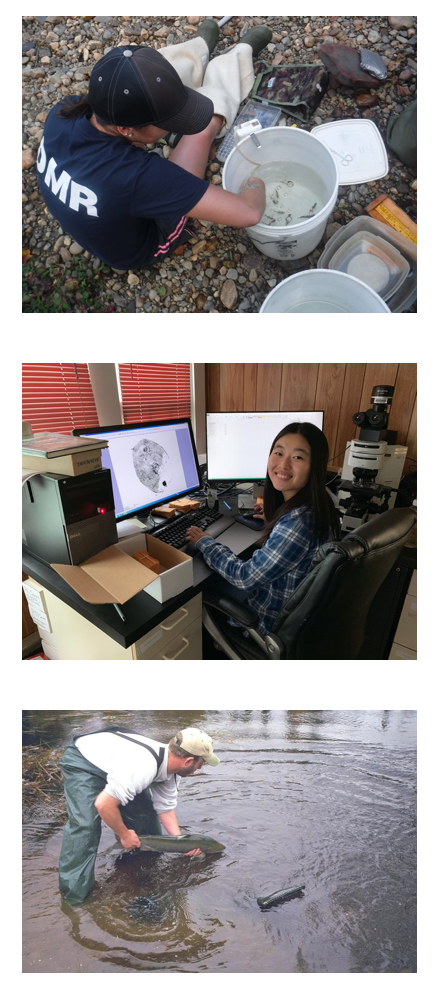
To be eligible for this program you MUST be enrolled or accepted in a degree-granting or
certificate program from an accredited institution in Maine AND enrolled at least half time (6 credits or more) in the Fall 2026 semester.
If you are interested in applying for an internship please email the 3 things below to Asia Alosa:
- A cover letter describing your interest in this opportunity and your preferred (top 3)
projects/locations. - A resume (including names and contact information for 3 references)
- A copy of your most recent unofficial transcript(s)
The deadline for applications is noon (Eastern) Thursday, January 15, 2026. Applications
submitted before the deadline will receive priority, but applications will be accepted until the positions are filled.
Please contact Asia Alosa with any questions.